Where the Wind Arrives First: Shelter Lessons from Cornwall’s Coastal Hedges
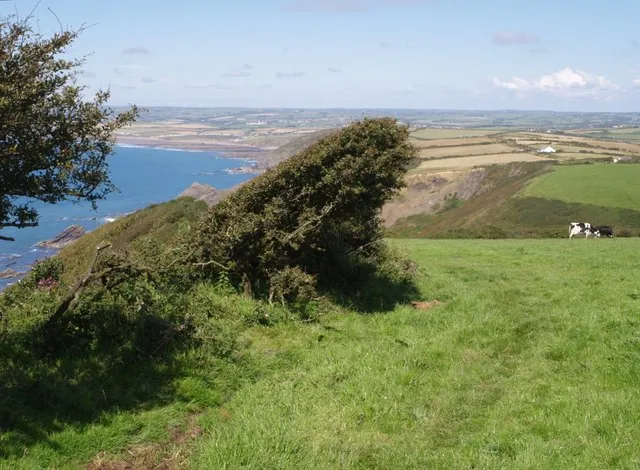
Photo: Derek Harper, CC BY-SA 2.0, via Wikimedia Commons
On a grey November morning near the north coast, the first thing you notice is not the garden but the hedge. It leans. Its windward face is cropped tight and slightly scorched, while the leeward side has let itself go a little, throwing out longer shoots and darker leaves. This is the salt line in action: the place where weather meets plants and the garden behind gets a chance to breathe.
Cornwall is good at this kind of boundary. Not because the county has some secret recipe, but because coastal gardeners here have been watching the same problem for generations. Wind, salt, wet soil and the occasional mild winter that lulls you into planting something tender. The hedge is the answer that keeps on answering.
The hedge as a working boundary
A good coastal hedge is not a wall. A solid wall will stop the wind, but it can also create a nasty little vortex on the sheltered side, with gusts curling over the top and down into the garden. A porous hedge does something subtler. It slows the wind, filters it, and takes the sting out of the salt. The air behind it is calmer rather than completely still, which is usually what plants want.
In Cornwall, that often means a Cornish hedge at the base, with earth and stone doing the heavy lifting, and a line of shrubs on top or behind. On more domestic boundaries, it might be a mixed hedge of Pittosporum, griselinia, Escallonia and blackthorn. The point is not to build a fortress. The point is to create a buffer with a bit of give in it.
What salt burn actually does
Salt burn is easy to recognise once you have seen it. Leaves on the exposed side go brown at the margins, then crisp, then drop. Evergreens often show it worst because their leaves are on duty all winter. Salt crystals land on the leaf, draw moisture out, and the wind finishes the job. It is not always fatal. A tough hedge can look battered in February and still push new growth in April.
Wind pruning is the other half of the story. On the windward side, exposed buds can be damaged or killed, so growth is directed away from the weather. The hedge becomes asymmetric. The windward face stays tight and dense, while the sheltered side stretches out. That shape is not a failure of pruning. It is the plant making a living in a difficult place.
The practical lesson is to work with that shape rather than fight it. Hard pruning into old wood can finish off some evergreens, and cutting a coastal hedge in autumn can leave tender regrowth exposed to winter gales. Late winter or early spring is usually kinder, once the worst of the weather has passed but before the main push of growth.
The plants that take the first hit
Blackthorn is one of the great outer defenders. It is deciduous, so it does not have to hold a full canopy through the salt season, and its spring blossom is a proper event. It also suckers, which is either a wildlife bonus or a maintenance headache, depending on your patience.
Tamarisk has a feathery, wind-tossed look that suits exposed places, and it is tolerant of salt and poor soil. Pittosporum tobira gives dense, leathery evergreen cover and a good windward face in milder coastal gardens. Griselinia littoralis is fast and bright, but it is not indestructible; in a severe cold snap it can be cut back, so it is often best used as an inner hedge or in a spot with some protection.
Other reliable names include Elaeagnus x ebbingei, Escallonia, Olearia and Euonymus japonicus. None of them is a magic bullet. The trick is to plant a mix, not a monoculture, and to accept that the outer line may look a little weather-beaten. That is what it is there for.
Lessons for a small, blustery plot
Start by watching where the wind actually goes. It rarely comes from one direction all year. A gap between buildings, a low fence, a driveway, a corner where two walls meet: these are the places where wind funnels and accelerates. Mark the salt line in your mind, then plant your toughest subjects on the exposed edge and your softer ones behind.
Plant small. A small hedge plant settles faster than a large one and is less likely to rock loose in autumn gales. Use a temporary windbreak netting if you need to, but keep it porous rather than solid. Mulch after planting, water through dry spells in the first year, and resist the urge to feed heavily. You want sturdy growth, not soft growth that the wind can shred.
Layering helps in a small garden. A low outer hedge of blackthorn or Escallonia, a middle line of Pittosporum or Elaeagnus, and then perennials and shrubs that enjoy the calmer air behind. Even a balcony or a tiny front garden can borrow this idea with pots and trellis, as long as the windbreak itself has some gaps for the wind to pass through.
The breathing space behind
A coastal hedge is not just a barrier. It is a microclimate. It slows the wind, reduces salt deposition, holds a little more warmth in the soil and gives insects somewhere to shelter. In Cornwall, the boundary is often the most hardworking part of the garden, even if it is the least glamorous.
So when you see a wind-shorn hedge on an exposed lane, do not read it as damage. Read it as a working plant doing a difficult job well. The garden behind it is breathing because of it. That is a lesson worth carrying inland, too, wherever the wind arrives first.