Borrowed Horizons: Designing a Small Garden Around the View Next Door
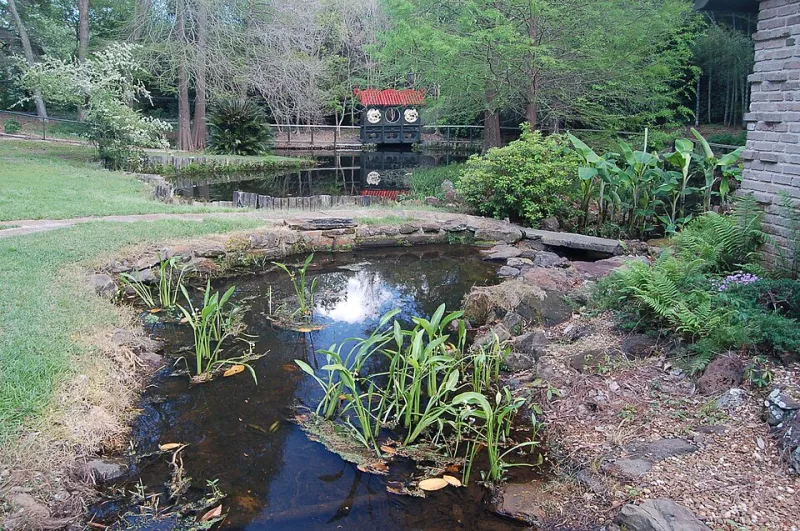
Photo: A. E. Crane, U.S. Department of Transportation, Public domain, via Wikimedia Commons
Cornwall is a county that likes to remind you it has an edge. Walk through a village garden on the Roseland and you might find a low granite wall doing less work than a hedge, a gap that frames a sliver of estuary, or a bench placed precisely where a church tower appears between two tamarisk branches. The plot itself may be modest. The view is not. This is the borrowed view in action: the garden designer’s old trick of treating the landscape beyond the boundary as part of the composition, rather than pretending the fence is the end of the story.
For gardeners with small UK plots, the idea is more than a pretty theory. It is a way to make a courtyard feel deeper, a suburban strip feel less boxed in, and a back garden feel connected to the place it happens to sit in. In Cornwall, the borrowed view is often coastal, but the principle travels. A church spire in a market town, a line of allotment poplars, a neighbour’s mature oak, the rise of a hill beyond a housing estate: all can be invited in.
Start with an audit, not a shopping list
Before you buy a single plant, spend a week looking outwards. Note where the best light falls, which distant features are visible from seated height, and when they appear. A view is not static. The church tower may be hidden by summer leaves and revealed in November. The sea might glint only in the late afternoon. A neighbour’s tree might be a nuisance in one season and the best thing on the horizon in another.
Sketch the garden from the house, then from the main seating area. Mark the obvious borrowed elements: rooftops, tree canopies, a hill, a water tower, a field edge. Then mark the intrusions: wheelie bins, a badly placed shed, a glaring security light. The first group is material to work with. The second group is what you screen, soften or redirect.
Frame, don’t grab
The Cornish boundary is often a lesson in restraint. A granite wall may be chest height, with a hedge behind it or a deliberate dip. The point is not to expose everything. It is to create a frame. In a small garden, that might mean a gap in a hedge, a pair of upright shrubs, an arch, or a section of fence lowered just enough to reveal a tree canopy beyond.
Framing works best when the eye is given something to land on. A borrowed view of a distant hill is pleasant; the same view seen through a carefully placed gap beside a pot is memorable. Think of the boundary as a picture mount rather than a wall. You are not stealing the landscape. You are editing it.
Borrow the tree, not the argument
Neighbourly trees are the most common borrowed view in Britain, and the most delicate. A mature birch or apple tree leaning over a fence can give a small garden height, movement and seasonal colour without costing a penny. It can also cause shade, leaf litter and the occasional difficult conversation.
Design with the tree, not against it. If it casts shade, use that side of the garden for ferns, hellebores and seating in hot weather rather than a sun-loving border. If it drops leaves, treat them as free mulch and a reason to choose robust ground cover. And if branches need pruning, remember that the tree belongs to someone else. A polite conversation is cheaper than a dispute and usually more effective than a hedge trimmer waved over the fence.
Let the horizon do the heavy lifting
Small gardens often fail because every square metre is asked to perform. The borrowed view can take some of that pressure off. If the eye is drawn outwards, the garden does not need to be packed with incident. A simple lawn, a gravel path and a few well-placed plants may be enough when the real drama is a distant woodland edge or a line of rooftops catching the evening light.
This is where negative space earns its keep. A patch of open ground, a low bench, a clear stretch of wall: these give the borrowed view room to breathe. Clutter at the boundary is the enemy. So is a tall, solid fence that turns a garden into a box. If privacy is the priority, consider a slatted fence, a see-through hedge or a raised planter with screening above eye level only where it is truly needed.
Echo the place, gently
Cornwall’s borrowed views are not only about what you can see; they are about what the view tells you. Coastal gardens often use grey-leaved plants, wind-shaped shrubs and gravel that echo the cliff and the sea. Inland, the palette might follow oak woodland, moorland or the stone of a church tower. The borrowed view becomes more convincing when the garden repeats a colour, texture or shape from beyond the boundary.
For a small UK plot, that might mean using the same warm brick as a neighbouring terrace, planting a row of field maple to echo a hedgerow, or choosing a bench painted the same green as a distant gate. These are small gestures, but they make a garden feel local rather than portable. They also stop the borrowed view from looking like an accident.
Keep it seasonal and honest
A borrowed view is not a permanent fixture. Leaves fall, crops are harvested, new buildings appear, and a neighbour may decide to plant a fast-growing conifer. Design for change. Take photographs through the year, note what works in winter, and avoid building the entire garden around a single distant feature that might vanish.
And be honest about the boundary. A borrowed view should not mean overlooking, surveillance or a garden that feels like it is peering into someone else’s life. In Cornwall, the best examples tend to be generous rather than grabby: a gap that shares a glimpse of the sea, a seat that looks towards a church tower, a hedge that allows a tree to be seen without exposing the kitchen window next door.
The small-plot lesson
A small garden can feel larger without becoming a stage set. The borrowed view gives it depth, context and a sense of belonging. Start by looking outwards, frame what is already there, screen what spoils the picture, and let the horizon do some of the work. In Cornwall, that might mean sea light and granite walls. In a Yorkshire terrace or a Kentish suburb, it might mean a church spire, a line of oaks or the low swell of a hill. The principle is the same: a garden is not only what you own. It is also what you notice.