A Ledger of Wet Days: Thirty Years of Weather-Watching in a Cornish Valley

The rain gauge sits just inside the gate at Jenny Pascoe's garden, fixed to a weathered post beside a clump of libertia. It is a plain plastic measure, the sort you can buy for less than a decent pair of secateurs, and it has been part of her morning routine for three decades. Before the kettle goes on, before the dog gets walked, Jenny pads out in her dressing gown to read the level. Then she writes it down.
Since spring 1996, she has kept a daily weather diary in a series of hardback notebooks. Rainfall, frost, wind direction, cloud cover, the odd note about a squall that snapped a branch or a mild night that brought slugs out early. The handwriting changes over the years, the notebooks get fatter or cheaper, but the habit has barely shifted. "It began because I wanted to know whether I was imagining the wet," she says. "I thought I was going mad. Every time I wanted to plant something, it rained. So I started counting."
The gauge by the gate
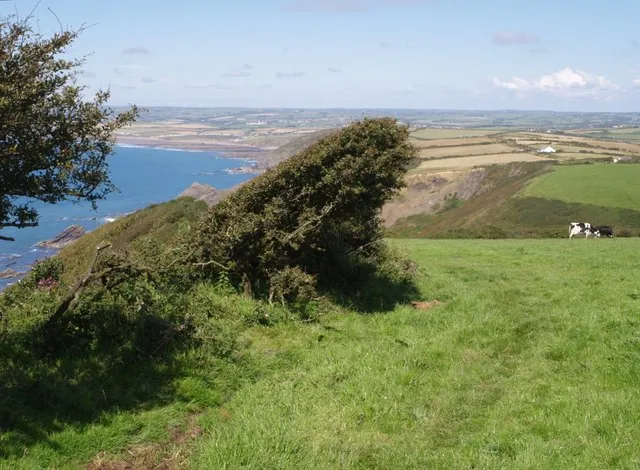
Jenny's garden sits in a tributary valley above the Helford, a few miles from Falmouth. It is not an especially grand plot: a sloping lawn, a productive patch, a greenhouse with more character than glazing bars, and borders that lean into the shelter of mature Cornish hedges. But the valley has its own microclimate. Cold air slides down the slope after dark. Rain arrives off the Atlantic in bands that can miss the next village entirely. Wind funnels through the gap between two wooded ridges.
"People say Cornwall is mild," Jenny says, "and it is, in a way. But mild and wet are not the same as easy. We get rain in quantities that make a mockery of the phrase 'a light shower'. And we get wind that doesn't so much blow as lean."
Her records are not calibrated scientific data. She freely admits that a cheap gauge in a breezy garden has its limitations. But the notebooks have a cumulative power that a single season never could. Looking back through them is like watching a slow conversation between gardener and place.
What thirty years of notes actually show
Some patterns are obvious. November and December are usually the wettest months, though not always. February can deliver a deceptive dry spell before the ground has warmed. Late frosts are rarer than in inland gardens but not unheard of, and they tend to arrive after a week of tempting soft weather. South-westerlies dominate, with the occasional brutal easterly that turns a mild day bitter and scorches tender growth.
More interesting to Jenny are the small sequences. A wet autumn followed by a cold snap. A dry April after a sodden March. A year when the first frost came early and caught the dahlias, and another when it never quite arrived. "You start to see that the garden is not responding to an average," she says. "It is responding to what happened last week, and the week before that. The notebook keeps me honest about that."
She is careful not to turn her diary into a grand climate statement. One valley, one gauge, one gardener. But she has noticed that the wet years feel wetter, and that the dry spells, when they come, bite more quickly. "I don't need the notebook to tell me that," she says. "But it helps me see how I've adapted."
Drainage lessons written in pencil
Those adaptations are visible across the garden. The first thing Jenny did, after about five years of watching water pool in the same low corner, was to stop fighting it. A shallow swale now carries water away from the vegetable beds and into a boggy patch planted with iris, marsh marigold and a robust gunnera. It looks intentional, though Jenny insists it is simply a wet corner that has been given a job.
Raised beds went in after a run of sodden winters made the clay soil unworkable. Gravel margins around the greenhouse stop the path turning into a slide. The greenhouse itself sits on a low brick plinth, and the water butts are linked so that an overflow doesn't flood the potting bench. None of these are radical ideas. What is unusual is how clearly they trace back to pencil notes: "pool by shed", "beds unworkable", "path like butter".
"A garden diary is a bit like a to-do list that writes itself," Jenny says. "You don't have to remember every problem. You just have to write it down and then read it back in the right mood."
Planting by pattern, not by promise
Her planting has changed too. She still grows roses, sweet peas and a generous amount of garlic, but the garden now leans towards plants that tolerate wet roots in winter and a quick drying out in summer. Hydrangeas do well. So do astrantia, persicaria and several salvias, provided they are given sharp drainage. The tender things live in pots that can be moved under cover when the gauge and the forecast agree that a cold night is coming.
She has also become a more patient waterer. In her early years, she watered by habit, often on evenings when the gauge would have told her the soil was already damp enough. Now she checks the previous week's rainfall before reaching for the hose. "It sounds obvious," she says. "But when you've had a hot day, the garden looks thirsty. The notebook says, actually, we had twenty millimetres on Tuesday. Wait."
That small pause has saved her time, water and, she suspects, a few plants lost to overwatering in heavy soil. It has also made her more relaxed about dry spells. "You learn which plants are genuinely suffering and which are just having a dramatic afternoon."
How to start your own garden weather log
Jenny's advice for anyone tempted to begin is deliberately unglamorous. Buy a simple rain gauge and put it somewhere open but not exposed to the worst wind. Use a notebook you like enough to keep using. Record the date, rainfall in millimetres, overnight minimum if you have a thermometer, wind direction and a few words about what the garden is doing. First frost, last frost, first daffodil, first slug damage. Nothing fancy.
"The trick is not to make it a project," she says. "Two minutes with a cup of tea. If you miss a day, write 'missed'. The notebook doesn't judge."
After a year, read it back. After three, you will have something more useful than memory: a record of how your own patch behaves. Not the weather as forecast for the county, but the weather as it arrives at your gate.
A small record against forgetfulness
Jenny is 68 now, though she looks annoyed at being asked. She has no plans to stop. The notebooks take up a shelf in the study, spines faded, some swollen from damp. She pulls one out from 2004 and reads a line aloud: "Wet, wet, wet. Wind SW. Tulips flattened. Sowed carrots anyway. Fool."
She laughs. "That's the whole thing, really. You make your plans, the weather answers back, and you write it down. Thirty years later, you realise you've been having a conversation with the garden all along."
For any UK gardener, that conversation is worth starting. You don't need thirty years to begin. You just need a gauge, a pencil and the willingness to notice what actually lands on your plot, rather than what you assumed would.