Slow Writers on the Gatepost: How Lichen Keeps a Cornish Garden's Air Record
The first thing Morwenna does is apologise to the gatepost. Not out loud, exactly — more a quiet 'mind out' as she leans past it with a hand lens, her sleeve brushing a patch of grey-green that has been there, presumably, since before either of us was born. It is a wet Tuesday in November, the kind of day when a Cornish garden seems to be exhaling. The apple trees are bare, the grass is a sponge, and every hard surface — slate, granite, timber — wears a thin skin of something that is not quite plant and not quite fungus.
A garden that keeps its own records
We are in a rented garden outside Lostwithiel: three old apple trees, a granite gatepost, a slate roof and a wall that leaks a little in winter. Morwenna is a naturalist who has spent years recording lichens across the county, and she has brought neither microscope nor clipboard. 'You don't need either,' she says. 'You need a wet day, a hand lens and the willingness to look at the same gatepost for ten minutes.'
Lichen, she explains, is a partnership: a fungus that provides the structure and an alga or cyanobacterium that does the photosynthesis. It is not moss, not mould and not a parasite. It grows slowly, colonises stable surfaces and is famously fussy about air. That fussiness is what makes it useful. Different species tolerate different levels of sulphur dioxide, nitrogen and damp. A garden's lichens are, in effect, a slow correspondence with the atmosphere.
Not moss, not mould, not a problem
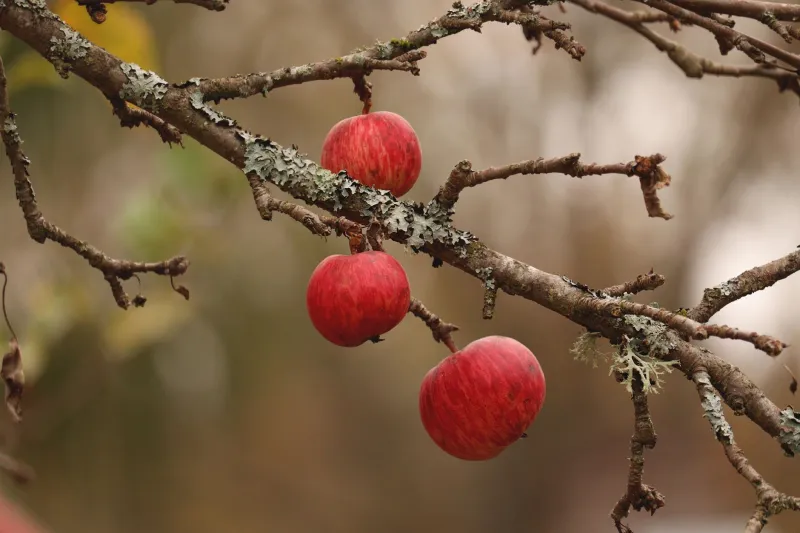
On the sunny side of the gatepost, a bright orange-yellow lichen is doing well. Xanthoria parietina, sometimes called sunburst lichen, is a nitrogen lover. It thrives where dust, fertiliser drift or traffic fumes leave a little extra nitrogen in the air. On the shaded apple branch above our heads, the grey-green leafy patches are Parmelia sulcata, a common foliose lichen with a network of fine cracks. Higher still, on a dying pear branch, a few tufts of beard lichen hang like tiny grey curtains — Usnea, a genus that generally prefers cleaner air.
Morwenna is careful not to turn this into a simple scorecard. 'A garden is not a laboratory,' she says. 'The gatepost is sunnier and drier than the apple branch. The apple bark is older and more porous. The wall is damper. You have to read the surface as well as the species.' She turns the gatepost gently. On the north face, where the rain sits longest, there is a powdery greenish film — Lepraria incana, a dust lichen that likes damp, shaded stone. On the smooth bark of a young ash by the hedge, if we look closely, there are thin dark lines like tiny writing: Graphis scripta, the script lichen. 'That one always looks as if someone has been taking notes,' she says.
The gatepost, the apple bark and the roof
We spend the next hour moving between surfaces. The slate roof has its own community — small crusty patches that can survive baking and frost. The old apple trees are richer, because nobody has scrubbed them. Their bark is rough enough to hold moisture and old enough to have been colonised many times over. The granite gatepost is a different story again: hard, slow to weather, but stable for decades.
'This is why I like gateposts,' Morwenna says. 'People clean them. They pressure-wash them. They paint them. But a gatepost that has been left alone is a little air-quality diary. You can see the nitrogen lovers on the sunny side and the damp lovers on the shady side. You can see what has arrived and what has gone.'
She admits that lichen recording can become an obsession. Once you start noticing the difference between a grey leafy patch and a grey crusty patch, you cannot stop. But the point is not to identify everything. The point is to notice change. A garden's lichen community shifts slowly, and that slowness is the message.
From sulphur to nitrogen: what Cornwall's air is writing now
Cornwall's air is generally cleaner than it was in the bad old days of coal smoke and industrial sulphur. The Clean Air Acts and the decline of heavy industry did a lot for lichens across Britain. Species that had vanished from city trees crept back. But the story has not ended. Nitrogen pollution from agriculture, traffic and domestic heating is now the bigger influence in many rural areas, encouraging nitrogen-loving lichens and putting pressure on those that prefer nutrient-poor air.
That is why a garden near a farmyard may look different from one on a clean coastal headland. It is also why the same gatepost can tell two stories at once: cleaner sulphur air, yes, but more nitrogen than before. 'It is not a verdict,' Morwenna says. 'It is a conversation. And it is happening very slowly, which is exactly why we need to pay attention.'
A five-minute habit for your own garden
You do not need a microscope or a species list to start. Pick three surfaces — a gatepost, an old fruit tree and a wall — and photograph them once a month. Note the colour, the growth form (crusty, leafy or shrubby) and which side of the surface faces the weather. Compare wet and dry days. A hand lens helps, but a phone camera will do. Leave old wood and stone alone where you can. Lichen is not a sign of disease, and scrubbing it off removes the very thing that is recording your garden's air.
'People often ask me what to do about lichen,' Morwenna says. 'The answer is usually nothing. Just look at it. It has been looking after itself for millions of years.'
As we leave, the rain has stopped and the gatepost is steaming slightly. The grey-green patches look brighter than they did an hour ago. The apple trees are still bare, but they are not empty. They are covered in slow writers, each one noting the air, the damp and the passing of another Cornish November.