The Circle Underfoot: Late-Autumn Fairy Rings in a Cornish Garden
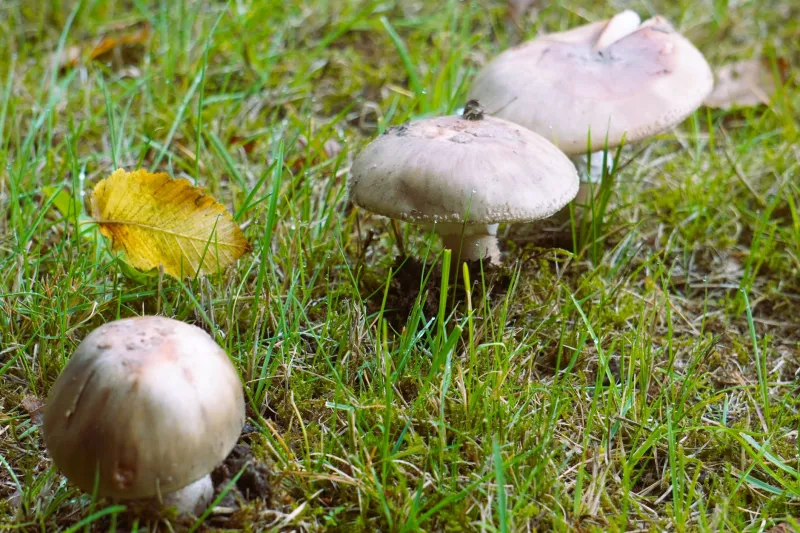
On a grey morning in mid-November, the lawn at a walled garden outside Truro is doing that thing lawns do when nobody is looking. Two dark-green circles have appeared almost overnight, one about a metre across, the other broken into a loose horseshoe near the apple store. The grass inside the smaller ring looks slightly flattened. At the edge, a line of small buff mushrooms is pushing through the dew.
Morwenna Teague, who has gardened here for eleven years, notices them before I do. She points with a trowel. 'Every autumn, same corner,' she says. 'I used to think it was the mower. Then I realised the mower doesn't do curves.'
A Ring You Nearly Miss
Fairy rings are easy to overlook until you are standing in one. From a distance they can look like a patch of richer grass, or a mowing mistake, or the place where a dog has been turning. Up close, the pattern is unmistakable: a circle of darker turf, often with mushrooms fruiting along its edge, sometimes with a paler or bare zone in the middle.
In Cornwall, where the autumn can swing from soft drizzle to proper soaking in a morning, lawns hold onto that moisture for a while. That suits fungi. The rings tend to become obvious just as the garden is winding down, when the grass is still growing but the mower is being used less often and the dew sits heavy until lunchtime.
Morwenna has a relaxed attitude to them. 'I don't panic,' she says. 'They've been here longer than I have. But I do want to know what they're up to. A lawn is a living thing, isn't it? It's not a carpet.'
What the Fungus Is Actually Doing
To get past the folklore for a moment, I asked Dr Ruan Penrose, a soil ecologist who has worked on grassland fungi in the south-west, what is happening under the turf.
'Fairy rings are the visible edge of a fungus growing outward through the soil,' he explains. 'The mycelium—the thread-like part of the fungus—starts from a point and spreads radially. The mushrooms are just the fruiting bodies, usually appearing at the active outer edge. As the ring expands, it can alter the grass around it.'
That alteration is what gardeners notice. The fungus is breaking down organic matter in the soil, and in doing so it can release nitrogen, which often gives the grass at the ring's edge a darker green flush. Some rings also create a zone where water does not soak in as readily, because the fungal threads and associated organic matter can make the soil temporarily water-repellent. That can lead to a dead or dry patch in the centre, or a ring of weaker grass.
'It is worth saying that not all fairy ring fungi are mycorrhizal,' Ruan adds. 'Many are saprotrophic—they feed on dead organic matter rather than partnering with plant roots. But they are part of the same underground world we are only beginning to understand. The ring is a sign of fungal activity, not a curse.'
He also makes a point that feels important in a garden context: a ring is not automatically a symptom of poor soil. It may simply mean there is organic matter to break down, that the turf is old, or that the lawn has been kept moist enough for the fungus to fruit. The ring is a clue, not a diagnosis.
The Stories We Still Tell
Knowing the science does not make the stories less interesting. If anything, it makes them stranger. Fairy rings have been blamed on dancing fairies, protected by charms, avoided by cattle, and treated as places where the ordinary rules of the garden loosen slightly. In Cornwall, where folklore and landscape have never been far apart, it is easy to see why a perfect circle in the grass would attract a story.
Morwenna laughs when I mention the fairies. 'My grandmother would have said it was the little people,' she says. 'She'd have told me not to disturb it. I'm not sure she meant the fungus.'
That is the thing about fairy rings: they arrive without permission, in a shape that feels deliberate, and then disappear again. They are a small reminder that the garden is not only made by the gardener. A lawn can look like a simple surface—mown, edged, controlled—and still be a place where something else is quietly drawing circles.
Reading the Lawn Like a Ledger
For practical purposes, Morwenna uses the rings as a prompt to look closer at the lawn. 'If I see one, I check the compaction,' she says. 'I check whether the thatch has built up. I check the moss. It's a reason to get the fork out.'
Ruan agrees that the response should be measured rather than dramatic. 'You do not need to reach for a fungicide every time you see a ring,' he says. 'In most domestic lawns, the best approach is to improve the conditions: aerate if the soil is compacted, scarify if there is a heavy thatch layer, water in dry spells, and overseed bare patches in autumn or spring.'
He adds that if a ring has produced a bare or dead zone, a gardener can fork the area, work in some organic matter, and reseed. But he also suggests leaving a ring alone if it is not causing a problem. 'They are part of the garden's ecology,' he says. 'A lawn with a few rings is not a failure.'
Practical Notes for Ring-Finders
If you find a fairy ring in your own lawn this autumn, here is a sensible, low-drama approach:
- Identify before you act. Take a photo, note the date, and look at whether the ring is dark green, bare in the middle, or lined with mushrooms. The pattern tells you more than the panic does.
- Do not eat unknown mushrooms. This is not a foraging article. Some fungi are toxic, and a lawn is not a safe identification classroom.
- Mow as normal. Regular mowing keeps the ring visible and stops the grass getting away from you.
- Aerate compacted areas. A garden fork pushed into the soil at intervals, or a proper aerator, can help water and air move again.
- Scarify if thatch is thick. A build-up of dead grass at the base of the lawn can hold moisture and favour fungal activity.
- Fork and reseed bare patches. If the centre has gone bare, loosen the soil, add a little organic matter, and overseed in a suitable season.
- Water wisely in dry spells. A lawn that is allowed to bake hard can make rings more obvious the following autumn.
- Leave one if you can. A ring in a less formal corner is a small piece of garden theatre. It costs nothing and asks nothing of you.
A Small Circle, A Long View
Back at the walled garden, Morwenna is not planning to wage war on her rings. She has a fork in the shed and a vague plan to spike the worst compacted patch, but the horseshoe near the apple store can stay for now. 'It's only a bit of grass,' she says. 'And it's quite a good shape.'
That feels like the right note. Fairy rings are a reminder that soil is not inert, that lawns are not merely green rectangles, and that a garden can still surprise you in November. The fairies may not be dancing. But something is. Under the grass, out of sight, a fungus is making its slow circle—and all we have to do is notice.