The Bud Ledger: Reading Next Spring in a Cornish Camellia Collection
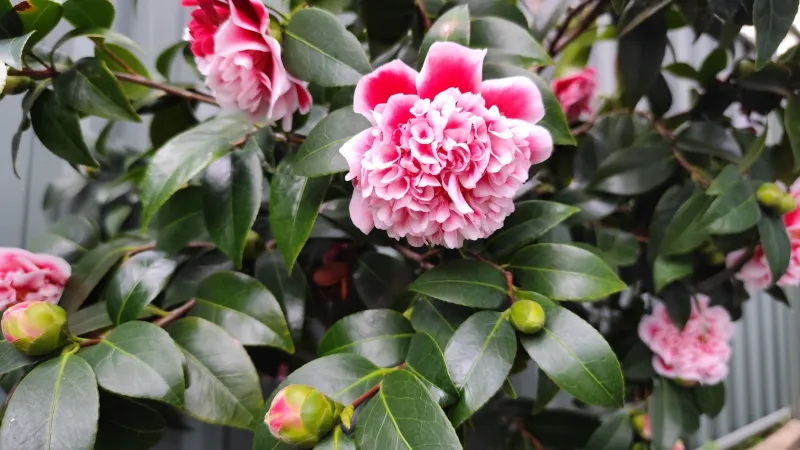
On a grey, bright-edged morning in mid-November 2026, the camellia collection tucked into a folded valley west of Truro feels less like a garden than a waiting room. The grass is flat with damp. The paths shine. And all around, in glossy evergreen layers, the camellias are holding next spring in tight green fists.
‘People come in March and say the garden is doing nothing until the camellias open,’ says Ellen Rowe, who has looked after this private collection for nineteen years. ‘But the real decision has already been made. These buds are next spring, sitting there in the cold.’
A collection that keeps its own time
Rowe’s garden is not a show garden. It is a working collection, planted along a slope where acid soil and high hedges do most of the heavy lifting. Camellias here are not lined up like soup tins. They are tucked behind rhododendrons, allowed to lean into paths, and pruned only when a branch threatens to take someone’s eye out.
By mid-November, most of the japonicas have finished setting for next year. The buds sit in the leaf axils, some no bigger than a pea, others already fat and faintly striped with the colour to come. A few early sasanqua types are flowering or finishing, but the main event is still months away. This is the quiet part of the camellia year, and for Rowe it is the most informative.
‘Flowers are lovely, but they are also a bit of a performance,’ she says. ‘The buds tell you what kind of summer the plant had and what kind of winter it is expecting.’
What a tight bud actually tells you
Rowe does a bud watch, though she would never call it that in public. She walks the same twelve plants each week from late September to Christmas, checking a sample branch on each. She notes bud size, bud drop, leaf sheen and whether the buds are clustered towards the sheltered side of the bush.
‘If the buds are plump and glossy, the plant had enough water when it mattered,’ she says. ‘If they are small and dull, I look back at August. Was it dry? Was the plant in too much shade? Did it get a late feed that pushed soft growth instead of storing energy?’
Camellias set their flower buds in late summer and autumn. A dry spell at the wrong moment can cause buds to abort before they ever show colour. So can waterlogging, which is less obvious in Cornwall but still possible in a wet valley bottom. Rowe lifts a few buds gently between finger and thumb. ‘A bud that feels papery at the base is often a goner. A bud that is firm and cool is doing its job.’
She also looks at where the buds are. A camellia that carries its buds only on the inner, sheltered wood is telling you something about wind. One that carries them evenly around the bush has found a kinder spot.
Shelter, frost pockets and the Victorian inheritance
Camellias reached Britain in the eighteenth century, but they really took hold in the 1800s, when plant hunters and nurserymen sent back selections from China and Japan. Cornish gardens, with their sheltered valleys and acid soil, became testing grounds for those introductions. The Victorian plant-hunting habit left behind a useful lesson: camellias like a woodland edge, not a cliff top.
‘Shelter is not the same as heat,’ Rowe says. ‘People think Cornwall is mild, so camellias must want full sun. Actually, they want to be out of the wind and away from the worst frost.’
Her collection has its own frost pocket, a low corner where cold air drains off the slope and sits. The camellias there are not dead, but they are later, more sparsely budded, and more likely to lose flowers to a sharp March frost. She has learned to leave a gap in the hedge to let cold air move on.
For gardeners outside the far south-west, this is the lesson worth taking: camellias are not fussy about being cold, but they are fussy about being cold and windy and wet at the same time. A sheltered west or north-facing wall is often kinder than a sunny south wall that coaxes them into early flower and then catches them out. Morning sun on frosted leaves can mark them, too.
Feeding, watering and the case for doing less
Rowe does not feed in November. ‘There is a temptation to give everything a little something before winter,’ she says. ‘With camellias, that is the wrong instinct. A late soft flush is a liability.’
Her feeding is modest: a light ericaceous feed in spring after flowering, and occasionally a little more in midsummer if leaves look pale. Mulch goes on as leaf mould or pine bark, kept away from the trunk. In dry autumns she waters newly planted camellias, because next year’s buds are already in the pipeline. Potted plants get rainwater when possible, and are raised on feet so they never stand in a saucer of winter wet.
‘They hate chalk, they hate wet feet, and they hate being fussed over,’ she says. ‘After that, they are quite reasonable.’
Lessons for gardens beyond the far south-west
For UK gardeners growing camellias outside Cornwall, Rowe suggests choosing late-flowering japonicas or reliable williamsii hybrids rather than gambling on early types. Plant in acid soil or a generous pot, shelter from the worst east wind, and keep the roots cool with mulch. If a hard cold snap is forecast, a loose hurdle or fleece on the windward side is more useful than wrapping the whole plant in plastic.
‘Treat the flowers as a bonus and the foliage as the point,’ she says. ‘Then a bad frost does not ruin the whole year.’
Back in the valley, the light is going. Rowe closes her notebook and looks at a camellia covered in tight, hard buds. ‘Nothing is settled yet,’ she says. ‘But the buds are there. That is the promise. The rest is weather.’